

Security research on memory allocators.
The glibc heap and the Linux kernel, studied through reproducible labs and GDB tooling for inspecting a live kernel.


The work here studies how two allocators behave — malloc in userland and SLUB in
the kernel — and publishes each finding as a lab that reproduces it: a target, a
launcher, and an expected result, so a claim can be checked rather than accepted.
| Allocator | A wrong read shows up as | |
|---|---|---|
| glibc | malloc, in userland |
a crash, at the point of the error |
| SLUB | the kernel's allocator | plausible data — the error stays hidden |
The second row is the reason for the kernel tooling. Without a way to inspect the object itself, an incorrect offset returns a value that looks valid, and nothing downstream reveals the mistake.
| Project | Scope | Scale |
|---|---|---|
| pwn4heap | glibc allocator behaviour as Python labs, one per branch a technique applies to | 69 techniques · 236 labs · glibc 2.23–2.39 · MIT |
| pwn4kernel | kernel memory behaviour as standalone QEMU labs, with mitigations enabled | 24 techniques · 66 labs · 26 builds · kernels 4.4–6.14 · GPL-3.0 |
| KernLens | 30 GDB commands for page tables, SLUB caches, struct page and KASLR |
Python · x86-64 · GPL-3.0 |
The 236 pwn4heap labs share 78 target binaries: the technique is the subject, and
each target ships the ld and libc of the branch it was built for. Every
pwn4kernel launcher boots with SMEP, SMAP, KPTI and KASLR enabled, so a lab
describes behaviour under the mitigations a current kernel actually has.
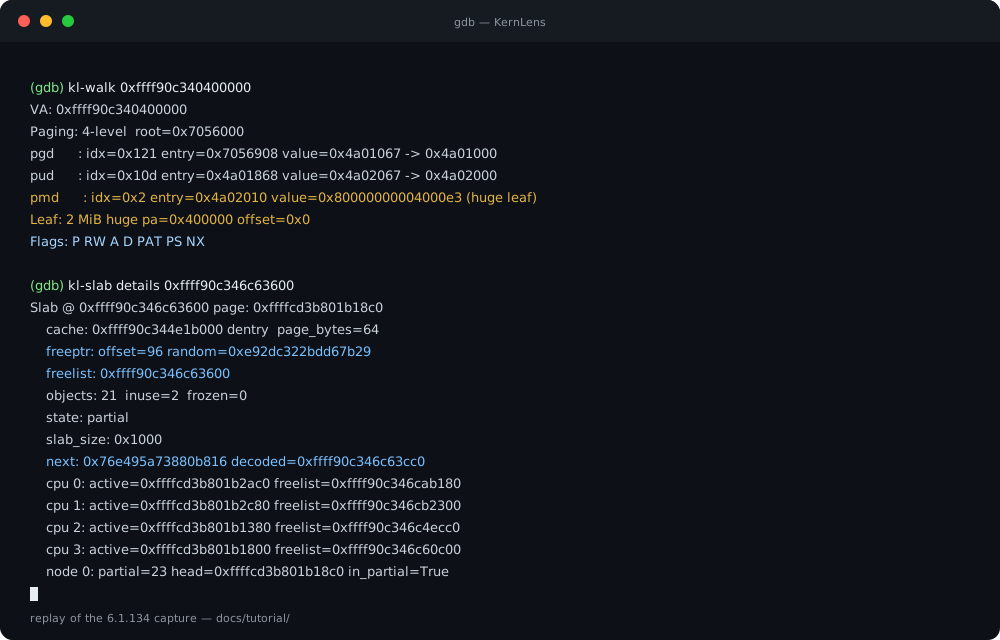
kl-walk decoding a 2 MiB page-table mapping, then kl-slab details decoding a
freelist pointer out of a real object chain on a 6.1.134 kernel — verbatim from a
recorded session.
KernLens reports the entry each answer came from, so an incorrect read is visible
rather than plausible, and resolves structure layouts from DWARF, then the image's
own BTF, then a versioned registry. That ordering is what lets it work on a
distribution's stripped vmlinux and not only on a debug package.
Systems programming in C, C++, Rust, Go and Python, with a focus on x86-64. Prior work: pwnable.kr and pwnable.tw, completed.
"First, solve the problem. Then, write the code." — John Johnson
blog · KernLens docs · PyPI